Fisetin 500mg: What Buyers Should Compare
A 500 mg label tells you the amount of fisetin per stated serving. It does not, by itself, tell you whether the formulation is appropriate, well tested or supported for your personal use.
Take the ReCellence Cellular Assessment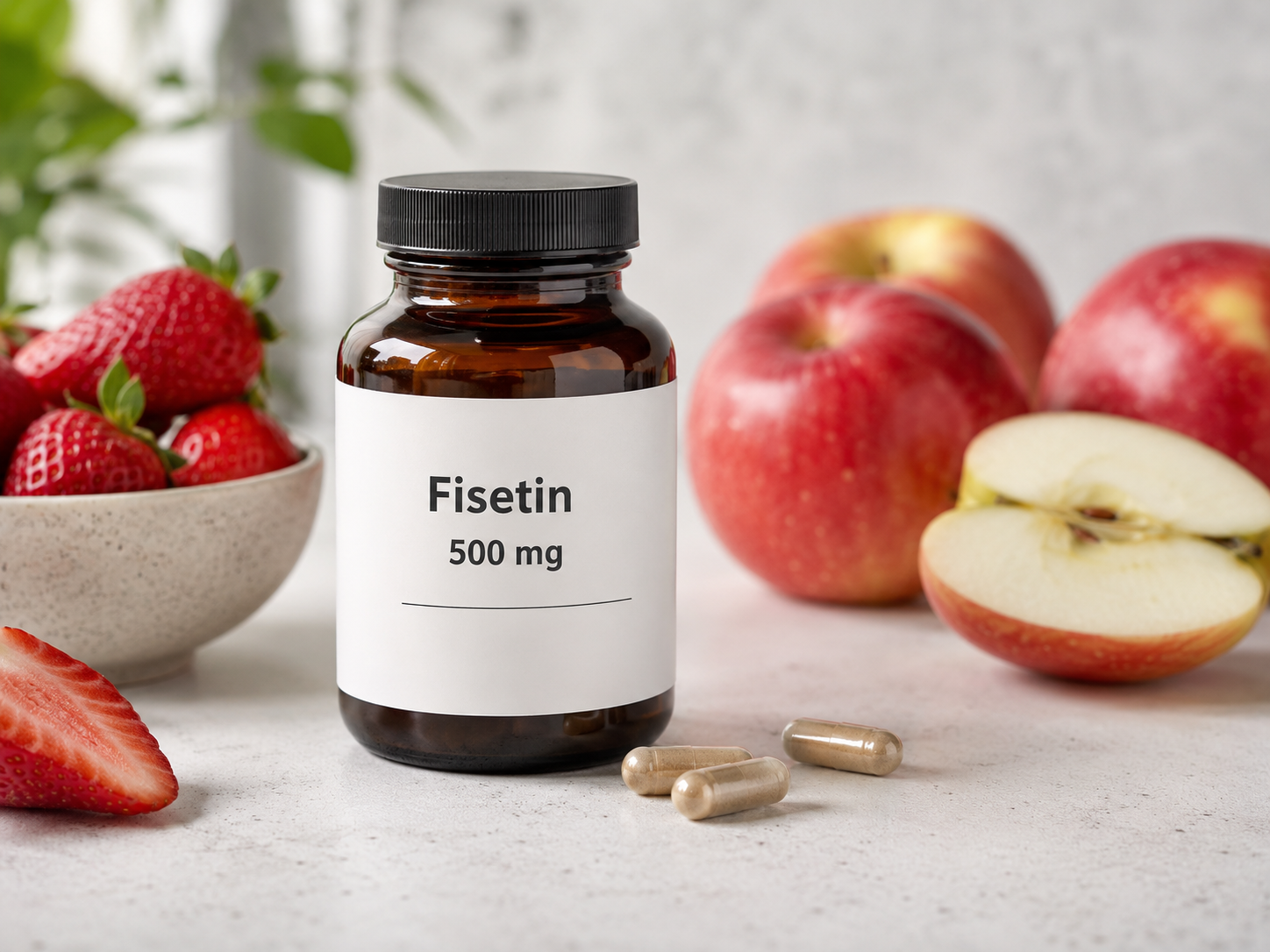
Dataset secondary target: fisetin 500mg · 1,300 searches/month · KD 14 · Transactional
Quick answer: this page is a buyer decision guide. Compare the exact label, serving basis, testing visibility, price context and evidence match before treating one headline feature as decisive.
What does “fisetin 500mg” mean?
For supplement shoppers, “500 mg” is first a product-format question. Compare whether 500 mg is provided per capsule, per two-capsule serving, or per daily serving. Also check whether the label clearly identifies fisetin rather than hiding it inside a proprietary blend.
Do not turn a research dose into personal dosing advice
Fisetin has attracted attention because laboratory and animal work has reported senolytic activity. Human trials are still developing. A registered pilot study is examining fisetin pharmacokinetics in healthy volunteers, while other clinical studies are evaluating specific patient populations. That makes it inappropriate to treat any number found in a paper as a universal consumer dose.
| Buyer check | What to look for |
|---|---|
| Stated fisetin amount | Exact mg per serving, not only blend weight |
| Serving size | Number of capsules/sachets needed to reach the labeled amount |
| Testing | Accessible quality or identity testing information |
| Formulation | Other active ingredients and whether they change the intended use |
| Claims | Avoid products promising to treat disease or “reverse aging” |
For neighboring comparisons, see Fisetin 1000mg, best fisetin supplements, and fisetin vs quercetin.
500 mg is a common high-dose commercial position, not a quality standard
Our Phase 3 sample includes multiple 500 mg products, but their prices, testing disclosures, container sizes and delivery strategies differ. A 500 mg label therefore gives you a dose anchor, not a complete quality comparison.
Frequently Asked Questions
Is fisetin 500 mg a standard senolytic dose?
No universal senolytic dose has been established for general consumer use. Human fisetin research is still developing.
Is more fisetin necessarily better?
No. A larger labeled amount does not automatically mean better evidence, safety, absorption or product quality.
What should I compare besides milligrams?
Compare serving size, ingredient transparency, testing, formulation, warnings and the quality of the evidence behind the claims.
What should I compare besides the headline dose?
Compare serving size, ingredient form, formulation, testing, warnings, evidence and price per serving.
Does a larger dose automatically mean a stronger effect?
No. Higher labeled amounts do not automatically translate into better absorption, safety or outcomes.
How important is product testing?
Testing can improve confidence in identity and quality when the documentation is specific and credible.
Are supplement claims the same as clinical evidence?
No. Marketing language should be checked against the actual type and maturity of the supporting research.
Can fisetin supplements be considered proven anti-aging treatments?
No. Current evidence does not justify presenting consumer fisetin products as proven treatments that reverse human aging.
Should I compare single-ingredient and multi-ingredient products differently?
Yes. Multi-ingredient formulas require transparent doses and a coherent explanation for why the ingredients are combined.
Who should discuss fisetin with a healthcare professional?
People with medical conditions, those taking medication, pregnant or breastfeeding individuals, and anyone considering high-dose or unusual protocols should seek professional guidance.
Research references
Research protocol versus personal use
Fisetin is a flavonoid found in foods such as strawberries and is widely discussed in longevity research because of preclinical work on cellular senescence. Commercial Fisetin products, however, vary substantially in dose, source, formulation, testing, and how aggressively they translate early-stage research into claims. A page about “Fisetin 500mg: What Buyers Should Compare” can summarize research dosing and commercial serving structures, but a study protocol is not a universal personal instruction. Published doses apply to a specific study design and population.
Why the number on the label needs context
A practical Fisetin comparison should start with the stated amount per serving, capsule count, ingredient source, formulation, testing documentation, visible COA availability, price per usable dose, and whether the finished product is a focused single ingredient or part of a broader stack. A dose number is meaningful only when the ingredient form, serving size, formulation, product purity, and schedule are clear. A large front-label number can still be a weak comparison if the underlying formula is poorly documented.
Pulse dosing deserves extra caution
Fisetin is often discussed in pulse-style senolytic protocols because of preclinical and translational research patterns. That does not make internet dosing schedules equivalent to validated clinical treatment. The gap between research protocol and personal medical advice is especially important here.
How Phase 3 changes this page
SenolyticReport Phase 3 adds a larger source-backed commercial database rather than relying only on narrative reviews. Product records capture Fisetin dose, current price where available, formulation, third-party testing, COA visibility, serving structure, and stack complexity. Missing fields remain missing rather than being filled with assumptions.
Transparency is a meaningful product feature
Two products can contain the same headline ingredient and still differ dramatically in how easy they are to audit. Clear dose, visible batch documents, testing disclosure, serving size, ingredient form, and current price reduce uncertainty. They do not prove efficacy, but they make a commercial product easier to evaluate.
How to interpret the Fisetin Value Score
The Fisetin Value Score is designed for products with enough verified dose and price information to support a cost comparison. It should not be read as an efficacy score. A cheap product can have weak transparency, and an expensive product can still lack finished-product evidence.
How to interpret Evidence Match
Evidence Match asks how closely a commercial product resembles the thing actually studied. A focused Fisetin capsule with a disclosed amount maps more cleanly to Fisetin research than a complex proprietary stack, even if the stack contains several fashionable longevity compounds.
Why stack complexity matters
Stack Complexity is descriptive rather than inherently positive or negative. A simple formula is easier to evaluate, while a multi-ingredient stack may be more convenient for someone who wants broader coverage. Complexity increases the burden of proof because more components create more dosing and interaction questions.
Price is only one part of value
Bottle price alone is a weak comparison. Useful value analysis considers the amount of active ingredient, number of servings, formula transparency, testing, and whether the product contains meaningful co-ingredients or merely decorative label complexity.
What would make the recommendation change
A recommendation should change when the market or evidence changes. New human studies, reformulations, price changes, new COAs, discontinued products, or improved testing documentation can all shift the comparison. Static “best” lists that never change are usually less useful than they look.
Practical checklist before buying
Before purchase, verify the current label, active amount, serving size, formulation, testing documents, warnings, price, refund terms, and whether the seller is the manufacturer or a third-party marketplace. If the product is being considered alongside prescription medication or for a medical condition, professional medical input belongs in the decision.