Fisetin vs Urolithin A
Fisetin is usually discussed through the senescence lens. Urolithin A is usually discussed through mitochondrial quality control and mitophagy. Those are not the same job.
Take the ReCellence Cellular Assessment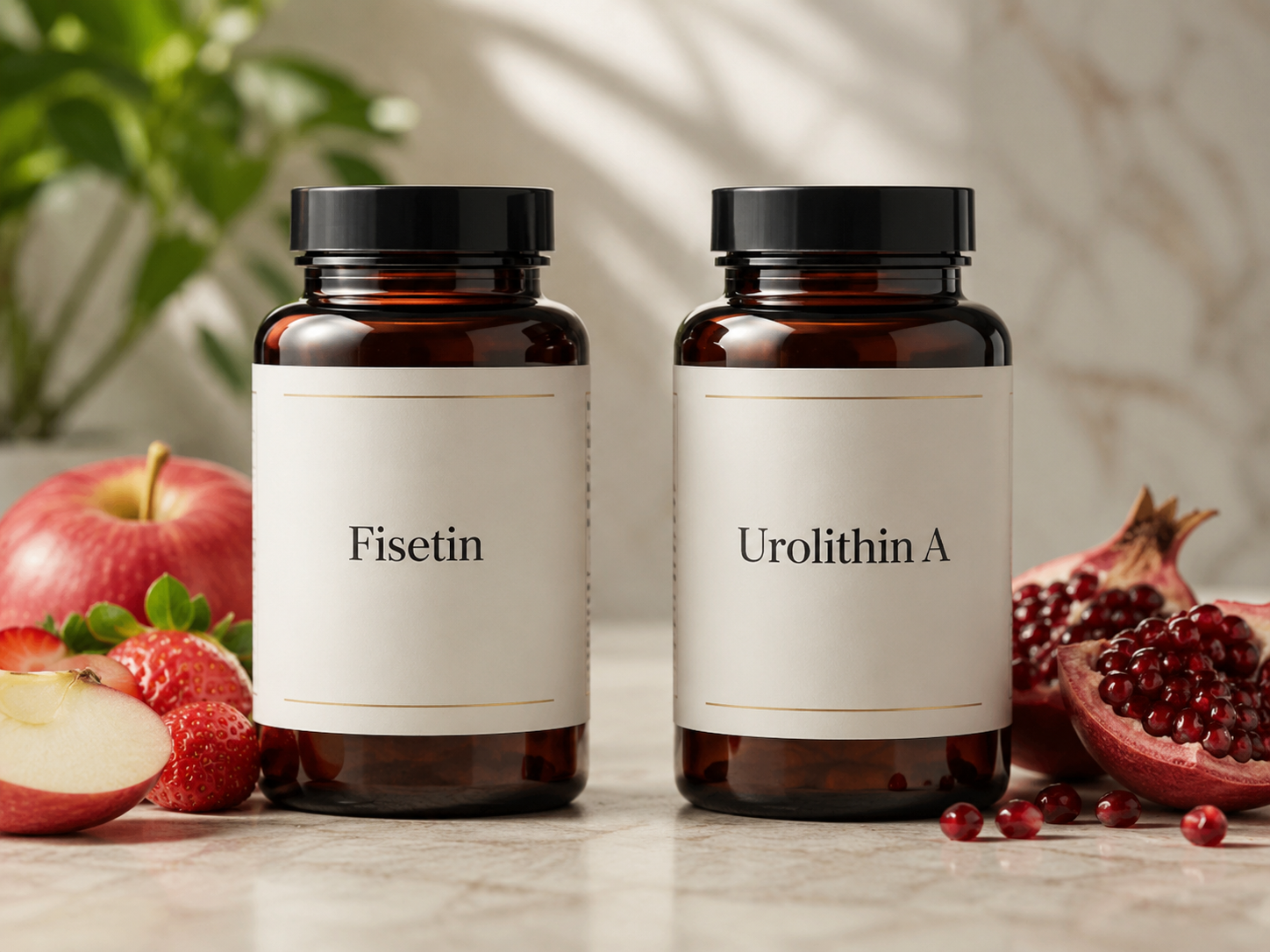
Dataset secondary target: urolithin a vs fisetin · 720 searches/month · KD 18 · Commercial
Quick answer: this page is a buyer decision guide. Compare the exact label, serving basis, testing visibility, price context and evidence match before treating one headline feature as decisive.
Direct comparison
| Feature | Fisetin | Urolithin A |
|---|---|---|
| Typical research framing | Senotherapeutic / senolytic | Mitophagy / mitochondrial health |
| Buyer intent | Senescent-cell targeting category | Mitochondrial-quality category |
| Same mechanism? | No. They are commonly researched and marketed around different cellular processes. | |
Why this matters for a supplement shopper
If you are comparing single ingredients, this is not merely a dose contest. Decide whether you are evaluating a senolytic concept, mitochondrial-quality concept, or a multi-pathway formula. Then compare the actual amounts, quality controls and evidence for the product you are considering.
ReCellence has dedicated research sections for both fisetin and Urolithin A, making its assessment relevant to readers comparing a broader cellular-health formulation rather than choosing only one ingredient.
What our expanded 2026 market database found
Senolytic Report now tracks 21 current fisetin and senolytic products. Verified fisetin servings span 8 mg to 1,500 mg, and the database separates conventional single-ingredient products from enhanced-delivery and multi-senolytic formulas instead of pretending they are directly interchangeable.
10 of 21 entries explicitly disclose testing or equivalent verification in the reviewed source, while 8 have a COA captured as visible. Explore the full database, Value Index and Transparency Report.
Frequently Asked Questions
Is Urolithin A a senolytic?
Urolithin A is better known in the research literature for mitochondrial quality control and mitophagy rather than being treated as equivalent to fisetin.
Can a product contain both fisetin and Urolithin A?
Yes, multi-ingredient products can combine them. The important questions are dose transparency, formulation rationale, quality and appropriate claims.
Which should I choose?
That depends on what you are trying to evaluate and your personal health context. Do not treat a mechanism label as medical advice.
What is the main difference in this Fisetin vs Urolithin A comparison?
The useful distinction is the compounds, mechanisms, evidence base, formulation and intended buyer goal rather than a simplistic winner.
Can the two ingredients be used in the same formula?
Products can combine multiple ingredients, but a combination should disclose each amount and explain the formulation rationale.
Does a higher milligram amount mean the better option?
No. Different ingredients cannot be compared fairly by milligrams alone because dose ranges, formulations and evidence differ.
Which option has better human evidence?
That depends on the outcome and population being studied. Compare specific human studies rather than broad longevity marketing claims.
Are preclinical findings enough to choose between them?
No. Cell and animal research can support a mechanism, but it does not establish a guaranteed consumer outcome.
What should I check on a comparison product label?
Check exact active amounts, serving size, other ingredients, testing information, warnings and the claims being made.
Can this comparison replace medical advice?
No. A product comparison cannot determine whether either ingredient is appropriate for your personal health situation.
Research references
Compare the ingredients with the same framework
Comparison pages are useful only when both sides are judged by the same criteria. Fisetin, quercetin, spermidine, Urolithin A, and resveratrol can all appear in longevity discussions, but they have different mechanisms, evidence bases, commercial formats, and dosing conventions. A page such as “Fisetin vs Urolithin A” should compare like with like. Mechanism should be compared with mechanism, human evidence with human evidence, and product structure with product structure.
Why comparisons often become misleading
One ingredient often looks stronger only because the page highlights its best evidence while using weaker or older evidence for the competitor. A useful comparison keeps the evidentiary standard symmetrical.
When there is no universal winner
A fair comparison keeps the framework symmetrical: active form, dose, human evidence, preclinical evidence, formulation, testing, serving burden, price, and stack role. The best choice can depend on whether the goal is a focused Fisetin product or a broader multi-pathway stack. Different compounds can occupy different roles in a longevity stack. A focused senolytic hypothesis, an autophagy-oriented ingredient, a mitochondrial ingredient, and a polyphenol do not need to be forced into one universal ranking.
How Phase 3 changes this page
SenolyticReport Phase 3 adds a larger source-backed commercial database rather than relying only on narrative reviews. Product records capture Fisetin dose, current price where available, formulation, third-party testing, COA visibility, serving structure, and stack complexity. Missing fields remain missing rather than being filled with assumptions.
Transparency is a meaningful product feature
Two products can contain the same headline ingredient and still differ dramatically in how easy they are to audit. Clear dose, visible batch documents, testing disclosure, serving size, ingredient form, and current price reduce uncertainty. They do not prove efficacy, but they make a commercial product easier to evaluate.
How to interpret the Fisetin Value Score
The Fisetin Value Score is designed for products with enough verified dose and price information to support a cost comparison. It should not be read as an efficacy score. A cheap product can have weak transparency, and an expensive product can still lack finished-product evidence.
How to interpret Evidence Match
Evidence Match asks how closely a commercial product resembles the thing actually studied. A focused Fisetin capsule with a disclosed amount maps more cleanly to Fisetin research than a complex proprietary stack, even if the stack contains several fashionable longevity compounds.
Why stack complexity matters
Stack Complexity is descriptive rather than inherently positive or negative. A simple formula is easier to evaluate, while a multi-ingredient stack may be more convenient for someone who wants broader coverage. Complexity increases the burden of proof because more components create more dosing and interaction questions.
Price is only one part of value
Bottle price alone is a weak comparison. Useful value analysis considers the amount of active ingredient, number of servings, formula transparency, testing, and whether the product contains meaningful co-ingredients or merely decorative label complexity.
What would make the recommendation change
A recommendation should change when the market or evidence changes. New human studies, reformulations, price changes, new COAs, discontinued products, or improved testing documentation can all shift the comparison. Static “best” lists that never change are usually less useful than they look.
Practical checklist before buying
Before purchase, verify the current label, active amount, serving size, formulation, testing documents, warnings, price, refund terms, and whether the seller is the manufacturer or a third-party marketplace. If the product is being considered alongside prescription medication or for a medical condition, professional medical input belongs in the decision.
Update trigger 1
For Fisetin vs Urolithin A, the conclusion should remain open to revision. New human studies, formula changes, updated COAs, price changes, and newly disclosed testing can all alter the commercial recommendation. The useful goal is not to create a permanent winner, but to make the comparison transparent enough that readers can see why the conclusion was reached and what evidence would change it.