Fisetin Supplements for Women Over 50: A Safer Buyer Framework
“For women over 50” is a useful buying context, but it is not a scientific dose calculator disguised as a birthday.
Take the ReCellence Cellular Assessment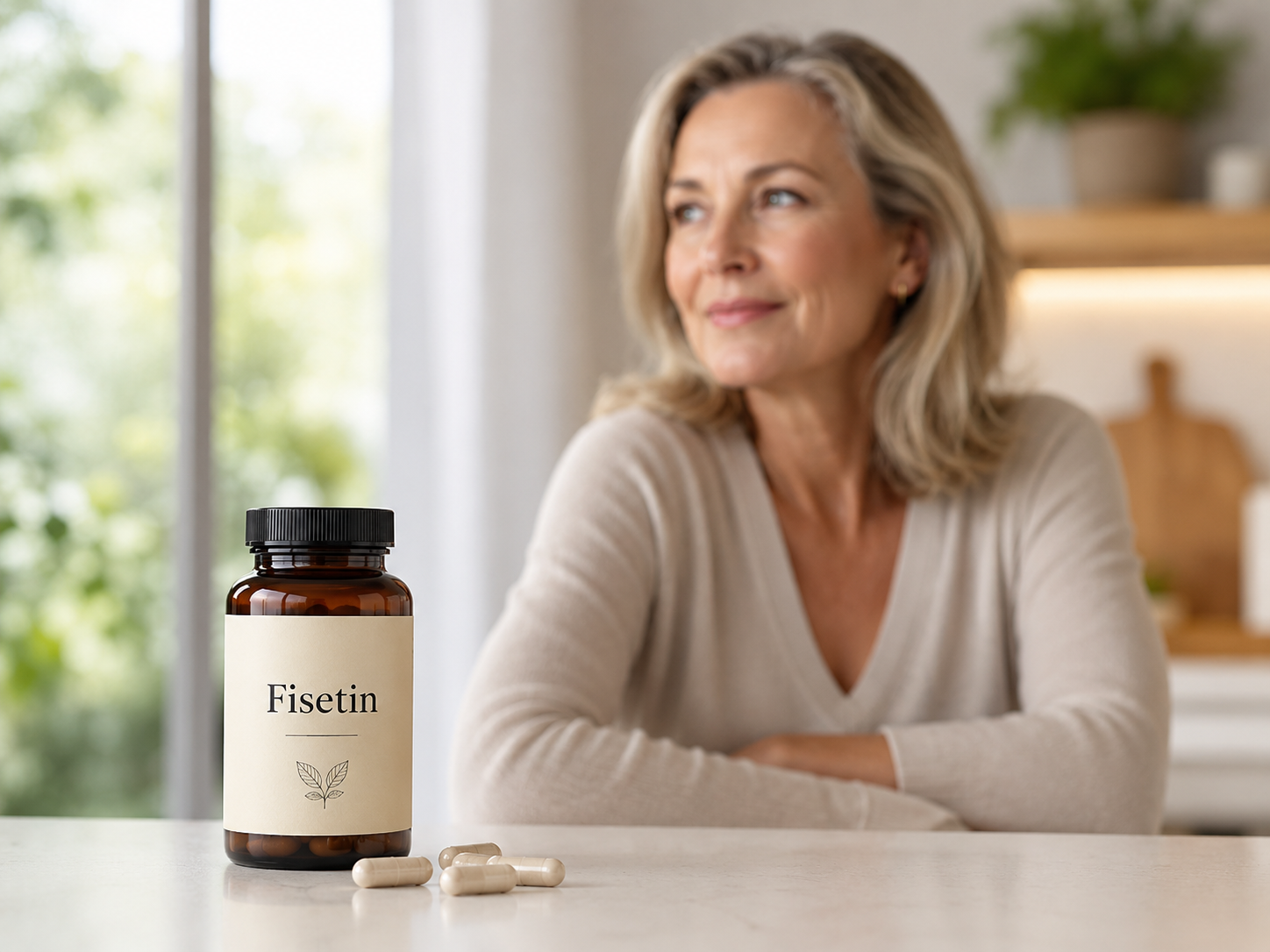
Quick answer: this page is a buyer decision guide. Compare the exact label, serving basis, testing visibility, price context and evidence match before treating one headline feature as decisive.
Why the modifier matters
Women over 50 may encounter fisetin through healthy-aging, menopause, mobility or longevity marketing. Those themes can overlap with genuine research questions, but age and sex alone do not determine whether fisetin is appropriate or what amount should be used.
Questions to ask before buying
- Is the product fisetin-only or part of a broader longevity formula?
- Are all active amounts stated clearly?
- Does the seller distinguish preclinical findings from human outcomes?
- Are medication and health-condition warnings easy to find?
- Is there a clear reason the product is positioned specifically for women?
ReCellence's current site is explicitly segmented for women and maintains research content on fisetin plus other cellular-health ingredients. Its assessment is therefore more relevant to someone comparing a broader women-focused formulation than to someone shopping for a fisetin-only capsule.
Also see fisetin 500mg and best fisetin supplement criteria.
Frequently Asked Questions
Is fisetin specifically proven for women over 50?
Human research is still limited and should not be converted into a blanket age- or sex-specific efficacy claim.
Do women over 50 need a different fisetin dose?
This site does not provide personal dosing advice. Age alone is not enough to determine an appropriate supplement dose.
What should I discuss with my clinician?
Bring the product label, current medications, supplements, medical conditions and the reason you are considering fisetin.
Does belonging to this audience determine the right fisetin dose?
No. Audience labels are useful for search intent but do not determine personal dosing or suitability.
What should this audience compare first?
Start with transparent ingredient amounts, evidence quality, testing, formulation rationale and warnings.
Are age- or audience-specific products automatically better?
No. The positioning should have a clear rationale rather than merely changing marketing language.
Should medication use affect supplement decisions?
Yes. People using prescription medication should discuss supplement use with a qualified healthcare professional.
Can a multi-ingredient formula be more appropriate than fisetin alone?
It can target a broader formulation concept, but more ingredients do not automatically mean better evidence or outcomes.
What evidence level matters most?
Human evidence relevant to the intended outcome is more directly informative than isolated cell or animal findings.
What is the biggest marketing mistake to avoid?
Do not treat a biological mechanism or audience label as proof that a product will deliver a specific personal result.
Research references
What safety evidence can support
Fisetin is a flavonoid found in foods such as strawberries and is widely discussed in longevity research because of preclinical work on cellular senescence. Commercial Fisetin products, however, vary substantially in dose, source, formulation, testing, and how aggressively they translate early-stage research into claims. Safety claims should be narrower than marketing claims. Short human studies can identify common adverse events in studied groups, but they cannot prove that long-term or high-dose use is risk-free for everyone.
Who should be more cautious
Medication use, pregnancy, surgery, liver or kidney concerns, significant medical conditions, and combining multiple supplements can materially change the risk picture. Those situations are not appropriate for one-size-fits-all internet dosing advice.
No reported problem is not the same as proven safe
Most of the strongest senolytic claims around Fisetin originate from preclinical or translational research. Human research is emerging, but commercial claims should remain narrower than the animal and cell literature. A product containing Fisetin does not automatically become a clinically proven senolytic. An absence of detected adverse events in a small or short study is useful information, but it should not be inflated into certainty across all populations, doses, or durations.
How Phase 3 changes this page
SenolyticReport Phase 3 adds a larger source-backed commercial database rather than relying only on narrative reviews. Product records capture Fisetin dose, current price where available, formulation, third-party testing, COA visibility, serving structure, and stack complexity. Missing fields remain missing rather than being filled with assumptions.
Transparency is a meaningful product feature
Two products can contain the same headline ingredient and still differ dramatically in how easy they are to audit. Clear dose, visible batch documents, testing disclosure, serving size, ingredient form, and current price reduce uncertainty. They do not prove efficacy, but they make a commercial product easier to evaluate.
How to interpret the Fisetin Value Score
The Fisetin Value Score is designed for products with enough verified dose and price information to support a cost comparison. It should not be read as an efficacy score. A cheap product can have weak transparency, and an expensive product can still lack finished-product evidence.
How to interpret Evidence Match
Evidence Match asks how closely a commercial product resembles the thing actually studied. A focused Fisetin capsule with a disclosed amount maps more cleanly to Fisetin research than a complex proprietary stack, even if the stack contains several fashionable longevity compounds.
Why stack complexity matters
Stack Complexity is descriptive rather than inherently positive or negative. A simple formula is easier to evaluate, while a multi-ingredient stack may be more convenient for someone who wants broader coverage. Complexity increases the burden of proof because more components create more dosing and interaction questions.
Price is only one part of value
Bottle price alone is a weak comparison. Useful value analysis considers the amount of active ingredient, number of servings, formula transparency, testing, and whether the product contains meaningful co-ingredients or merely decorative label complexity.
What would make the recommendation change
A recommendation should change when the market or evidence changes. New human studies, reformulations, price changes, new COAs, discontinued products, or improved testing documentation can all shift the comparison. Static “best” lists that never change are usually less useful than they look.
Practical checklist before buying
Before purchase, verify the current label, active amount, serving size, formulation, testing documents, warnings, price, refund terms, and whether the seller is the manufacturer or a third-party marketplace. If the product is being considered alongside prescription medication or for a medical condition, professional medical input belongs in the decision.
Update trigger 1
For Fisetin Supplements for Women Over 50: A Safer Buyer Framework, the conclusion should remain open to revision. New human studies, formula changes, updated COAs, price changes, and newly disclosed testing can all alter the commercial recommendation. The useful goal is not to create a permanent winner, but to make the comparison transparent enough that readers can see why the conclusion was reached and what evidence would change it.
Update trigger 2
For Fisetin Supplements for Women Over 50: A Safer Buyer Framework, the conclusion should remain open to revision. New human studies, formula changes, updated COAs, price changes, and newly disclosed testing can all alter the commercial recommendation. The useful goal is not to create a permanent winner, but to make the comparison transparent enough that readers can see why the conclusion was reached and what evidence would change it.